It has always been our intention to remain online as we travel so we can record our trip as well as share with others as we mooch around the country. For readers from overseas, (of which there appears to be a growing number, particularly via the SBMCC web community in the UK - Welcome folks) I should explain that whilst there are a number of Australian carriers who can provide wireless broadband, there is only one network that can provide coverage away from major population centres - Telstra NextG. They claim to reach 98% of the population & often state this as meaning countrywide coverage, which in fact is nowhere near reality. Recent estimates are that coverage is approximately only about 20% of the Australian land mass. This 20% is along most major highways & around most towns. In the outback it is common to have coverage 30kms either side of a town, & then no coverage for 100’s of kilometres until the next town. Nevertheless the coverage that is available is useful enough to make it worthwhile having whilst travelling. Just in the past couple of days members of the CMCA forum have been entertained by real time reports & photos from BBarry who got his bus bogged in soft sand at the old Fitzroy Crossing, in remote country in North West Western Australia.
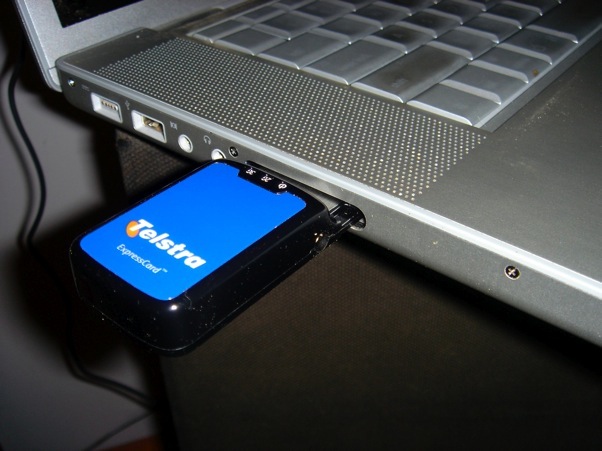
There are many webpages around that advise the best way to connect to the internet whilst travelling. These sites are invariably out of date, as the technology changes rapidly. For that reason I won’t attempt to advise, instead simply informing you of what I have done. My equipment is just our Apple laptop (Macbook Pro) to which I have recently added an Express card modem (pictured above).It is the Sierra Aircard 880E, powered directly from the laptop, allowing me to be online whilst sat under a shady tree away from the bus. Others have advised me that purchasing a high gain aerial will extend the coverage we are able to get, but as yet I haven’t bought one. Will get one if/when it proves necessary. The most popular modem amongst travellers is known colloquially as the ‘Blue Toaster’ & can be cheaper, as with that model there is a slower connection available at almost half the monthly price for data transfer. Attractive though that is, the Blue Toaster is called a ‘relocatable’ modem, & requires a 240v power supply to run it. This is easy enough to achieve in a motorhome, using an inverter, BUT, it does mean that usage is confined to inside the vehicle. Any cables (power supply, antenna) can be a real pain in the confines of a motorhome.
Cost of the 880E from Telstra is getting on for $600, but I purchased one through Ebay for $220. We went for a casual datapack deal, which allows us to vary our package from month to month. We expect to generally use the 1 gigabyte data per month ($89 per month), but can reduce this to a $5 ‘retainer’ for months when we won’t be using it. No ongoing contract. (For those prepared to commit to a two or three year contract, the cost of the modem is much less.
I look forward to sharing with you from paradise!
regards
Cuppa