28th September - 29th September 2009
We finally left Katherine (again!) & drove once more up the Stuart Highway to Pine Creek, where we stopped for a bite to eat at Mayse's cafe after first checking that we didn't once again have a pool of oil under the bus. (All dry - phew!). Topping up our fuel tank at the servo I noted the large stain we had left on their forecourt a week earlier. In our 'distracted' state we had failed to mention the mess to the servo attendant, & still said nothing this second time around, instead just leaving with a slight sense of guilt. This time, instead of leaving Pine Creek on the back of a southbound tow truck, we headed east under our own power, onto the Kakadu Highway & into our country's best known National Park.
Kakadu is huge & is I believe the only National Park in the world that encompasses a complete river system.
Amongst travellers there are those who say "Kakadu" & those who say "Kaka-don't". Following our time there we believe that the majority who say the latter are those who have failed to appreciate what Kakadu is, most likely the result of a rushed trip. Many 'do' Kakadu in 3 days. With the heat up around 38 -40 degrees every day rushing anything is extremely tiring. Dragging yourself around the 'sights' when hot & tired is no fun, & makes it impossible to allow Kakadu to soak into one's being, I know, I did this 10 years ago. This time we still rushed it more than we would have liked, due to the 'mechanical delays' we have experienced, but have at least managed to appreciate what we have seen & experienced over 10 days. A return visit with a 4wd has been placed onto our future agenda. Without a 4wd vehicle, there is still plenty to see, especially if not averse to a few corrugations.
Our first couple of nights were spent at Gunlom Falls, a beautiful spot with croc free swimming at the end of 37kms of badly corrugated road, which took us 2 hours & 10 minutes to drive! With camp established we had the choice of a steep climb to idyllic warm pools of water, looking out over the lip of a waterfall across endless forest, or the deeper, more easily accessed pandanus lined plunge pool at the bottom of the falls. We took both options - several times. :-) One evening we strolled amongst wild horses as we walked around the Murrill billabong & on to the South Alligator River.
30th September 2009
After packing up slowly, we again conquered the corrugations over another couple of hours before getting back onto the bitumen, driving on into Kakadu, to Cooinda, stopping for a walk to the Bukbukluk Lookout on the way. After booking for the the next day's early morning boat cruise on nearby Yellow Waters billabong & wetlands, we set up camp in the caravan park & went to cool off in the pool. Chlorine! Yuk! However in the absence of fresh water to cool down in, even I was persuaded to soak in the chemicals!
1st October 2009.
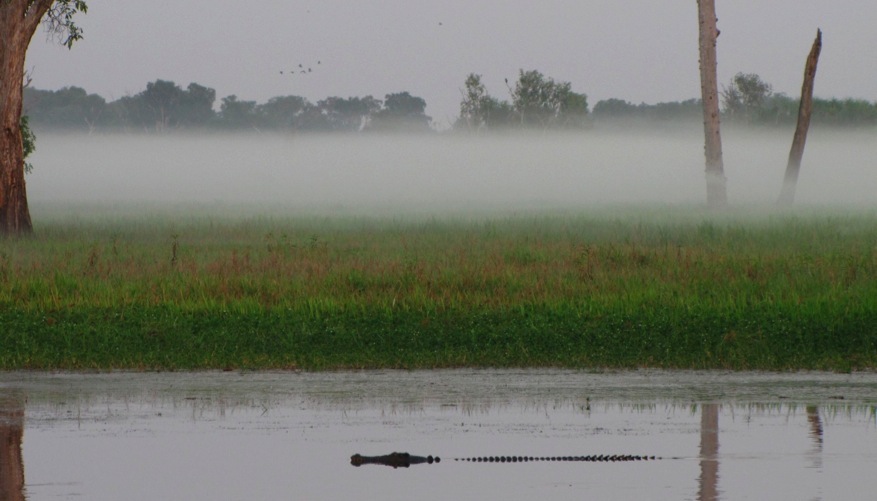
Wow! What away to start off a new month. At 6:45am we, & around another 40 passengers pulled away from the boarding jetty into raw nature at it's best. Rich carpets of green, covered in a layer of early morning mist, surround pristine waterways in which crocodiles cruise by within touching distance & a huge variety of birds did their daily thing totally unphased by our presence. It would be easy to run out of superlatives to describe being in this place & still not do it justice. It was every bit as good as when I had seen it with my son 10 years ago. MrsTea was blown away seeing it for the first time. Hopefully some of my photos will help to give a flavour, but this is a place where you just have to go to yourself.
Following an unusually huge buffet breakfast, included as part of the tour, we packed up again & drove to Muirella Park where we sat in the shade of trees at the edge of the large Djarridin billabong for lunch & a spot of fishing. Afterwards we walked the 'Bubba' walk, 5kms around a lovely billabong where we watched Jabiru's & several pairs of Brolgas. Moved on to Malabanjbanjdju campground for the night. A good spot that we had totally to ourselves, we decided to stay a second night. A good base for exploring the area around Nourlangie Rock.
2nd October 2009
Out on the bikes. Visited the Nawurlandja Lookout - another view over never ending forest & in this instance giving glimpses of the Anbangbang billabong nestled in the trees below. Afterwards we sat down at the billabong watching waterbirds of many descriptions. As on every other waterway Magpie Geese dominated the numbers, but Plumed Whistling ducks, various Egrets & Spoonbills were plentiful here too. Later we walked around Nourlangie Rock, home of Namarrgon the lightning spirit. This is one of the many ancient rock art sites in Kakadu that are publicly & easily accessible. Later we walked the 6km walk to Gubara Pools, a long hot trudge to a small pocket of Monsoon rainforest & water pools with concentrated mosquitos & large green flies!
3rd October 2009
As we were packing up to drive to the small township of Jabiru, MrsTea said those words that inevitably lead to that sinking sickening feeling in the bottom of one's stomach. "Umm, I think you should have a look at this" as she stared underneath the bus. Sure enough another oil leak. This time only minor compared to the previous blown rear main seal, & coming from somewhere on the front of the motor. Not disastrous, but definitely something that won't get better on it's own, & something that does nothing for the needed sense of trust in our new motor. Bollocks! We drove into Jabiru, thinking we might get someone to diagnose the problem & get some idea about whether we could 'live with' the leak for a while, or if it needed fixing immediately. We had not considerd that the only workshop in town would be closed, it being a Saturday. So for now I will continue to monitor the leak & the dipstick level. After stocking up with supplies at the supermarket, which *was* open, we headed north to the Merl campground, close to Cahills Crossing, the Border Store & Ubirr Rock. The crossing, over the East Alligator River, is one of only two entry points to Arnhemland, the river being the border. Permits from the Northern Land Council are required to enter Arnhemland, available in Jabiru, but again not on a Saturday. Many go across, drive a few kms to Oenpelli where there is apparently a very good Aboriginal art gallery. You have to drive straight to the gallery without stopping & without taking any photos, & then straight back again - it is a condition of the permit - so another camper informed us. We didn't go, but hope to one day spend some significant time in Arnhemland when we have a more suitable vehicle. Imagine a whole 'country' with no bitumen roads.
Cahills crossing, although not getting much of a mention in most of the tourist info, was a real highlight. You just have to be there at the right time. The right time is a little before high tide, although it can be quite tricky to determine just when high tide will be. The bloke running the Border Store didn't have a clue. Luckily the first time we went down to the crossing happened to be the right time. It was 'Crocodile Central'. All big salties, up to around 5.5 metres I estimated. As the tidal water flows upstream over the crossing, fish, mainly mullet, become dinner for the crocs. Many fish jump & slither their way across the road, & many become croc tucker. Up until now we have seen crocs lazing on banks & moving slowly through still waters. Here the muddy waters of the East Alligator were quite fast flowing, & the crocs managed to remain 'stationary' against the flow by waving their powerful tails & holding up their feet as though waving. Best was when they caught fish, rapid action, chomping jaws, head out of the water, sometimes tail too in an arched body manner. This was truly exciting stuff, close enough to see just what was going on, & the spectacle, with almost continuous action, lasted for more than an hour. Excellent stuff. First time was at around 11am. Next day we returned at a similar time, to find the tide was right out. Puzzled as we expected the tide times to only change a little each day??? As we walked away on the second day a busload of tourists was being taken to view the crossing. Sadly like many they would leave having seen just a river crossing, not knowing how close they had got to a real adrenaline hit. We were told about the action by fellow travellers Al & Maz (Thanks guys), & now you all know too, if indeed you didn't already know.
Later we walked along the Manngarre trail, a walk through fruit bat encrusted monsoon forest along the bank of the river. A section is for women only. MrsTea returned from this section excitedly, telling me she had seen a Spangled Drongo. This bird appears unremarkable bar two things. It's distinctively shaped tail & it's silly name. We had found this bird called a Drongo in our bird book ages ago & joked about hoping to see a real drongo. (In Australian drongo is a term of mild abuse, maybe something like a 'dropkick' or 'fool'). I was most jealous, but later we saw several in the campground & even managed to photograph one.
The days temperatures are averaging 39 - 40 degrees C, but this temperature is reached before 10 am & stays until evening. Nights cool to around 28-30 degrees C making sleeping a bit uncomfortable at times. A bus heated by the suntakes a long while to cool down, it's body still being warm to the touch at dawn. As long as there is air movement it is 'survivable'. Inside the bus, although generally only a few degrees higher than outside, lack of air movement results in us shedding body fluids at a rate that would be useful in more drought stricken parts of the country! The solution is simple, an electric fan, when the mozzies make staying outside too hard.
4th October 2009
Lazy morning culminating in another bout of croc watching. Later visited Ubirr Rock, probably the most accessible rock art site. Here paintings as old as 20,000 years remain on the rocks, several different styles from different periods, many are the very fine & detailed 'X-ray' style paintings. Most of the paintings reflected traditional food sources in the area, but some showed stories of events, even including a white man complete with hands in pockets! We looked out across the brilliantly green wetlands from the top of Ubirr rock, but missed most of the sunset after engaging in a competition with a fellow bus traveller - who had the worst 'mechanical hard luck story'. I think I won, but empathised with his continuing overheating problems, despite haven 'thrown' a heap of money at it along the way, to people that professed to know what they were doing, but clearly didn't. So familiar. He was driving a 38' Hino.
5th October 2009
Walked the Bardedjilidji trail, taking us through eroded sandstone outliers & 'secret canyons' looking like they should be a backdrop to a fantasy movie. These outliers were once island pillars in a shallow inland sea. Occasionally we would come across rock paintings, no protective rails, just as they have always been. One showed a sailing ship, others were much older, believed to have been painted by the Mimi spirits, (creation beings). In a cave we found a grinding stone, it's hole worn over many thousands of years.
6th October - 7th October 2009
We left Merl Campground early in the morning (getting up at first light gives a couple of relatively cool hours), driving back to the Arnhem Highway close to Jabiru, turned right (westward) toward Darwin. Stopped at the most amazing place - Mamukala Wetlands. Before we ever reached Kakadu, some had told us not to bother as it was 'all dry'. Dunno where those people went but we found water everywhere, including lots of it here at Mamukala. Guide books suggest that October is the best time to visit Mamukala. As the waters evaporate during the dry season, the wetlands contract (still huge though) resulting in concentrations of birdlife. As we stepped out of the bus some distance from the water the sound of birds, similar to being close to a children's playground at morning recess, gave no indication as to what we were about to discover. As we turned the last corner of the path & got our first view across the wetlands, I found myself laughing with the joy just seeing birds in such numbers & of such variety. Millions of birds, as far as the eye could see, even with binoculars! Wall to wall birds. Jabirus, pelicans, egrets, jacana's, spoonbills, various hawks, ducks, ibis, & many more unidentified. My photos will give but an idea of what we were looking at, they can't really do it justice. A highlight here was watching mobs of pelicans forming circles & collectively 'driving' fish, & then all feeding together in a frenzy. It looked like a 'mad dance'. We saw many fish caught by many species of bird. Must be a heck of a lot of fish to sustain such numbers!
After time in the 'hide' as well as a walk around the Mamukala wetland (despite still smoking bush from an obviously recent fire), we left the birds & in fact, Kakadu also, stopping a short distance outside of the park boundary at Bark Hut Inn. This is basically a roadhouse servicing the big mobs of tour buses that travel through these parts. Directly opposite Bark Hut Inn is a white gate, through which a dirt road leads to Annaburroo Billabong & Homestead. This is a delightfully rustic & & quaint campground owned & run by Margaret in her 'retirement' years after 40 years living in PNG. She's a real sunwashed character, & not afraid to call a spade a spade. We booked in just for the night, a very reasonable $7.50 per person included use of canoes on the billabong, which is a spring fed one, & free from croc danger, so emminently 'swimmable', especially as it's water was just the right temperature to walk into without the tiniest gasp when reaching the 'goolie - line'! The original bark hut (a place where the old buffalo hunters would stay) is on the property as are many examples Margaret's slight eccentricity. Apparently the place just recently got a special mention in the latest Lonely Planet guide to Australia, so will probably change with new found popularity over the next year or two. Margaret is proud of the entry, but rues that things won't be the same as just relying on word of mouth. Cruising up & down the billabong in a canoe at various times of the day & night allowed us to get up close to a variety of birds, & the wallabies that feed on the green grass around the water's edge. Swimming involved taking just a few steps from our camp which looked out over the water, from under shady trees. Another bird that we had found in our bird book & hoped to see one day was the 'Dollarbird. A medium sized bird, predominantly blue (of various shades) but with a bright red bill, & a silver 'dollar' under each wing. We hoped to see one because they looked so pretty. At Annaburroo every tall tree had a pair sitting on the top most dead branches. occasionally they would swoop close to the water allowing the sun to show off their 'blue-ness'. Mostly they looked black against the sky, but their 'dollars' could be seen along with their red bill. Trying to photograph them was a frustrating exercise. Capturing fast moving birds on high zoom levels is something for the more experienced photographer than me!
We liked the place so much we decided to stay another night. I am sitting typing this, watching MrsTea having yet another swim just out past the lilypads. life is pretty good at Annaburroo. We've just had a visit from several carloads of aboriginal men. They were out for a swim & a good time. They shared some of the 'bullock' they cooked on the fire with us & told us a little of their connections to this country, whilst listening to distorted pop music on one of the car's stereo's. 'Bullock' & 'Killer' are generic terms for beef. We have seen the occasional butchered carcase left out in the scrub for the eagles, crows & dingoes to clean up. We had no idea where, how or when this 'bullock' was killed, but sharing the tucker was a matter of respect. Having borrowed our sharp knife & salt, feeding us became essential. Amongst the banter, shouting & occasional swearing there was much politeness. A couple of hours later & after much shaking of hands, they all jumped back into their 4wd's & once again we had just the noise of the birds & insects ............... & the occasional a thunder like rumble & gunfire - carrying across from country used by the the military just outside Kakadu's boundaries.
I expect that I'll upload this entry in the next day or two, when we get back into signal range, closer to Darwin & can get a 'net connection. We are uncertain how long we'll be in Darwin for, probably not that long, us not being city slickers. I'm expecting to find a very different Darwin to the one I visited briefly 10 years ago. Since then the Darwin has been connected to the south via rail for the first time, & the city has I believe seen a huge expansion. We are thinking probably just a few days, but I also want someone to suss out the oil leak for me, & not sure how long that might take.
Right enough typing - time for another dip.
regards
Cuppa.
Please click HERE for photos of Kakadu.